This unit is found on the R259 models dating from 2001 to 2005+ in all their iterations, including the Rockster models. We are going to deal with those inputs/outputs associated with engine operation, please understand that there are many other functions controlled by the ECU, which will not be addressed by this document. I think is proper to acknowledge that the Motronics system is not current state of the art engine control, but it served the intended purpose at the time.
Inputs
Ambient air temperature – This sensor is located on top of the airbox and its function is to measure the temperature of the ambient air. A change in temperature results in a change of resistance, the ECU applies a voltage and reads the changing voltage as a function of temperature. Colder temperatures offset the A/F ratio towards and enriched mixture. Some owners, like yours truly, have mapped the resistance change as a function of temperature while other owners have installed a resistor in parallel with the sensor to fake the signal the ECU reads so as to increase the A/F ratio. This is one of many stop gap solutions to address the surging issues associated with this particular model.
Engine rpm – This input is straight forward and along with other inputs populates to the ECU defines the opening and closing of the injectors and the amount of fuel delivered.
Engine temperature – I believe it has a minor effect during cold operation, albeit I don’t know to what extent and enables the main A/F map when the engine reaches “operational temperature”
Throttle Position Sensor (TPS) – Black box attached to the left Throttle Body (TP). Innocuous in its appearance, it is one of the most important sensors as it is the one that defines the load on the engine. Operation is quite basic, inside there is a variable resistor that operates between 0 and 5 vdc, within that range, from .355 mvdc to about .410 mvdc is the signal that the ECU has earmarked as the indication that the engine is idling, then from .410 mvdc to ~5 vdc (actually neither of the limits is used to insure that the reading is always with the range) which tells the computer the amount of load on the engine. Early on, some of the BMW Techs used to increase the idle voltage to the .410 mvdc level by rotating the TPS as a solution to customers surging complaints as it acts on the A/F enrichment as well. If you ever get the urge to check the voltage of the TPS by using a safety pin (with the engine off) roll back the insulation and prick the rearmost wire on the plug, measure voltage (mvdc) to ground. This can be done with the key on without starting the engine.
O2 sensor – This presents a bit of a challenge by way of explanation as its influence is somewhat limited in this application This sensor is the narrow band type, in essence a first generation sensor, slow in response (1 sec) and primarily designed for use during steady state operation. Now I need to introduce you to two concepts that might be confusing. Open loop and closed loop operation of the engine. Basically what it means that in closed loop the O2 sensor has an effect on the operation of the engine and in open loop it doesn’t, in this specific case. It is important to mention that existence of wide band O2 sensors that are significantly faster and are used continuously in more advanced engine control systems.
One has to realize that any IC powered vehicle has to satisfy three primary objectives: Power, Economy and Emissions. This requires some engineering concessions as one parameter can not be maximized without affecting the other two, so with due diligence by the OEM some allowances have to be made. In this case the O2 sensor operates in the closed loop mode, what it means is there is a set of conditions where the O2 sensor will control the A/F mixture to improve economy. I don’t really know the applicable parameters, but in this case it is related to: engine at operating temperature, throttle opening and amount of change during a defined time and possibly rpm level.
Once a load demand is placed on the engine, like quick opening of the throttle, all bets are off and the O2 sensor control is displaced by a market specific (please remember this term) A/F map stored in the ECU memory while the system then is said to be operating in open loop. Does it make sense now?
CCP Plug – Plug located inside the fuse box, far to the left. In the US market it is yellow in color and sometimes not fitted to the bikes. On the earlier surging note BMW Techs have been known to remove such prior to bike deliveries and during service visits in response of the surging issues as its removal disables the O2 closed loop operation and enables the richer A/F map. Other markets don’t use the CCP or have different colors. The ECU, if memory serves me, has 5 different A/F ratio maps, each one accessed by the specific jumper selection on the CCP plug.
Outputs
Injector firing – The injectors always have a 12 vdc applied to them while the key is on. The ECU fires the injector by turning a transistor on to sink the negative leg of the injector to ground. The amount of time that the transistor is turned on defines the amount of fuel the injector will allow to pass. Generally speaking the injector is a solenoid (a coil) that lifts a plunger from its base (rough description) which allows the pressurized (3 Bar or 44 psig) gasoline to flow into the combustion chamber and mix with the incoming air. It is interesting to note that the injectors fire both at the same time, except that one is in the compression stroke and one isn’t. Generally speaking the activation time for an injector is in the milliseconds range, with the shortest time being ~ 1.5 msec and the max defined by the engine rpm, in this case ~ 16 msec (pundits, please check me out on this at 8000 rpm)
Spark - Fairly straight forward and limited by the inputs. There might be a minor amount of firing offset as a function of engine temperature to mitigate pinging, but I would be surprised if there is. I don't know if in the 4 plug models the is a slight delay in the firing of the lower plugs to allow added movement of the incoming mixture in the combustion chamber.
Last but not least, after many years of trials and tribulations with the brand, the one adjustment (assuming the engine is in a reasonable state of tune) that will most affect the surging issue, is a good, really good TB sync. Remember that there are two fairly large cylinders (just under 4” in diameter) opposing each other and their power contribution depends on both cylinders seeing the same amount of air.
I hope that this outline provides the owners with a better understanding of their engine operation.
Understanding the operation of the Motronics 2.4 ECU
Moderator: Moderators
-
boxermania
- Quadruple Lifer
- Posts: 3644
- Joined: Thu Mar 17, 2005 6:37 pm
- Location: Baton Rouge, LA.....aproaching retirement
Understanding the operation of the Motronics 2.4 ECU
Last edited by boxermania on Tue Oct 13, 2009 7:44 am, edited 1 time in total.
Member #312
06 Suzuki Burgman 650 "state of flux"
79 CBX
06 Suzuki Burgman 650 "state of flux"
79 CBX
Re: Understanding the operation of the Motronics 2.4 ECU
Hm. Both injectors fire simultaneously? I've seen this before, and wondered about it then...
That means that -- looking at one cylinder -- the intake valve is closed, and no air's moving through the throttle body. Injector fires, coating the walls of the throttle body. Nothing happens for a while. Then the intake valve opens and the injector fires again as a blast of air atomizes the fuel and carries it into the combustion chamber. Does that sound right?
I can see why they have the plugs fire simultaneously; no harm done if a plug fires on the exhaust stroke.
That means that -- looking at one cylinder -- the intake valve is closed, and no air's moving through the throttle body. Injector fires, coating the walls of the throttle body. Nothing happens for a while. Then the intake valve opens and the injector fires again as a blast of air atomizes the fuel and carries it into the combustion chamber. Does that sound right?
I can see why they have the plugs fire simultaneously; no harm done if a plug fires on the exhaust stroke.
#388 '02 R1150R Black: The darkest color.

Re: Understanding the operation of the Motronics 2.4 ECU
Thank you boxermania-san for that comprehensive summary.
From your statement:
Why? Wouldn't that exacerbate surging (and burn a hole in the piston )
)
From your statement:
I gather that these riders were seeking a leaner mixture?while other owners have installed a resistor in parallel with the sensor to fake the signal the ECU reads so as to increase the A/F ratio
Why? Wouldn't that exacerbate surging (and burn a hole in the piston
)Rich
ADIOS!
ADIOS!
Re: Understanding the operation of the Motronics 2.4 ECU
Yes, it would be much better to have the injectors timed to the cam rather than the crank, but at least it's a huge improvement over Bosch's early CIS system. CIS=Continuous Injection System, that's right, the injectors are always spraying with the volume of fuel controlled by fuel pressure.NoRRmad wrote:Hm. Both injectors fire simultaneously? I've seen this before, and wondered about it then...
Actually I've read that the wasted spark has some beneficial side effects of cleaning the plugs, as long as the RPMs are low enough to allow the coils to sufficiently re-charge (not an issue with our motors).NoRRmad wrote:I can see why they have the plugs fire simultaneously; no harm done if a plug fires on the exhaust stroke.
Frank
'04 R1150RA Titan Silver
-
CycleRob

- Honorary Lifer
- Posts: 2857
- Joined: Mon Mar 21, 2005 12:29 am
- Location: Enjoying retirement in Gainesville GA. USA
- Contact:
Re: Understanding the operation of the Motronics 2.4 ECU
"I think it is proper to acknowledge that the Motronics system is not current state of the art engine control, but it served the intended purpose at the time".
Correct. It is possibly THE cheapest way for EFI to be applied to a Boxer twin engine. No idle control motors, no detonation sensor, one O2 sensor and predominately TPS/RPM fueling control. Both sparkplugs and both fuel injector pairs fire simultaneously, every crankshaft turn. Clearly, manufacturing cost reigned supreme. Somehow in development it got all the way thru BETA testing without getting any red demerits for surging. Maybe no one rode it that way or the accountants had the final say.
Practically every one of those character flaw parameters was advanced 2 giant steps with the introduction of the R1200GS HexHead engine. 2 idle control motors, 2 separate ignition programs and 2 separate injection systems for each cylinder. 2 detonation sensors and 2 O2 sensors. They must have given in after hearing for too many years about the surging and how disappointed the owners were in the way they ran. The newer HexHead also got better fuel economy, even though the final gearing had the engine turning faster, a hydraulic lash camchain adjuster to make it quieter -and- a balancer shaft to make it even smoother. Much lighter weight, much faster . . . . everything got better . . . . except the MSRP. Oh well.
Now that I own an 800cc water cooled BMW with the latest BMS-K CAN-bus engine management system, I can truthfully say they have learned their lesson so well that it will be hard to take the tuning perfection for granted. It is that good. Instantaneous throttle response, flawless glass smooth throttle transitions, a wide fat power curve and excellent fuel economy capability together in the same bike means the marriage between a computer and an engine has finally been perfected. Yes, we have come a long way since breaker points, carburetors and the ground breaking mechanical CIS. I am impressed.
.
Correct. It is possibly THE cheapest way for EFI to be applied to a Boxer twin engine. No idle control motors, no detonation sensor, one O2 sensor and predominately TPS/RPM fueling control. Both sparkplugs and both fuel injector pairs fire simultaneously, every crankshaft turn. Clearly, manufacturing cost reigned supreme. Somehow in development it got all the way thru BETA testing without getting any red demerits for surging. Maybe no one rode it that way or the accountants had the final say.
Practically every one of those character flaw parameters was advanced 2 giant steps with the introduction of the R1200GS HexHead engine. 2 idle control motors, 2 separate ignition programs and 2 separate injection systems for each cylinder. 2 detonation sensors and 2 O2 sensors. They must have given in after hearing for too many years about the surging and how disappointed the owners were in the way they ran. The newer HexHead also got better fuel economy, even though the final gearing had the engine turning faster, a hydraulic lash camchain adjuster to make it quieter -and- a balancer shaft to make it even smoother. Much lighter weight, much faster . . . . everything got better . . . . except the MSRP. Oh well.
Now that I own an 800cc water cooled BMW with the latest BMS-K CAN-bus engine management system, I can truthfully say they have learned their lesson so well that it will be hard to take the tuning perfection for granted. It is that good. Instantaneous throttle response, flawless glass smooth throttle transitions, a wide fat power curve and excellent fuel economy capability together in the same bike means the marriage between a computer and an engine has finally been perfected. Yes, we have come a long way since breaker points, carburetors and the ground breaking mechanical CIS. I am impressed.
.
`09 F800ST
Member since Sept 10, 2001
"Talent, On Loan, From God" --Rush Limbaugh--
Member since Sept 10, 2001
"Talent, On Loan, From God" --Rush Limbaugh--

Re: Understanding the operation of the Motronics 2.4 ECU
I always wanted to know how the R1150R deals with the lean oxygen air at higher altitude.
The bike doesn’t have an atmospheric sensor nor an intake manifold pressure sensor so I reckoned the oxygen sensor will be used to trim the injectors duration when cruising at higher altitude roads.
What will happen when the rider opens the throttle quickly to overtake a car at a higher altitude road? The Motronics switch to open loop map and ignore the signals from oxygen sensor, will the rider feels a sluggish acceleration since the open loop map is fixed and I believe it is programmed for sea level environment?
The bike doesn’t have an atmospheric sensor nor an intake manifold pressure sensor so I reckoned the oxygen sensor will be used to trim the injectors duration when cruising at higher altitude roads.
What will happen when the rider opens the throttle quickly to overtake a car at a higher altitude road? The Motronics switch to open loop map and ignore the signals from oxygen sensor, will the rider feels a sluggish acceleration since the open loop map is fixed and I believe it is programmed for sea level environment?
-
boxermania
- Quadruple Lifer
- Posts: 3644
- Joined: Thu Mar 17, 2005 6:37 pm
- Location: Baton Rouge, LA.....aproaching retirement
Re: Understanding the operation of the Motronics 2.4 ECU
NoRRmad
You are correct, when the cylinder is in TDC the injector fires. atomizes the fuel and is mixed with the incoming air.
Don't now if the wasted spark has any benefits, the rotation is 180 degres out of phase, the exhaust valve is open or about to open, there is nothing to combust in the chamber.
Sunbeemer
Arigato gozai mas......Actually as the ECU senses the cooler ambient air it enriches the mixture slightly.
frankc
For those familiar with the automotive CIS sytem, they were the first designs to comply with environmental requirements and as such fairly elemental. Interestingly enough, the Porsche 911 CIS systems of the late 70's were notorious for having ignition in the plenums during cold starts which resulted in the destruction of the air box (ouch, $$) as the system fired all injectors at once (6 in this instance). A pop-off valve was designed that would relieve the pressure during this ocurrences and save the airbox.
Phanng
Great observation. Since the engine doesn't have a MAP sensor there is no way to compensate for altitude. So it will depend on the reference altitude the OEM used to set up the ECU algorithm and the input of the ambient tempearture sensor as the temperature cools down with altitude. I would guess it will run on the lean side at higher altitudes......after the temperature sensor range is topped out.
You are correct, when the cylinder is in TDC the injector fires. atomizes the fuel and is mixed with the incoming air.
Don't now if the wasted spark has any benefits, the rotation is 180 degres out of phase, the exhaust valve is open or about to open, there is nothing to combust in the chamber.
Sunbeemer
Arigato gozai mas......Actually as the ECU senses the cooler ambient air it enriches the mixture slightly.
frankc
For those familiar with the automotive CIS sytem, they were the first designs to comply with environmental requirements and as such fairly elemental. Interestingly enough, the Porsche 911 CIS systems of the late 70's were notorious for having ignition in the plenums during cold starts which resulted in the destruction of the air box (ouch, $$) as the system fired all injectors at once (6 in this instance). A pop-off valve was designed that would relieve the pressure during this ocurrences and save the airbox.
Phanng
Great observation. Since the engine doesn't have a MAP sensor there is no way to compensate for altitude. So it will depend on the reference altitude the OEM used to set up the ECU algorithm and the input of the ambient tempearture sensor as the temperature cools down with altitude. I would guess it will run on the lean side at higher altitudes......after the temperature sensor range is topped out.
Member #312
06 Suzuki Burgman 650 "state of flux"
79 CBX
06 Suzuki Burgman 650 "state of flux"
79 CBX
-
riceburner

- Basic User
- Posts: 3809
- Joined: Fri Mar 18, 2005 7:54 am
- Location: Hiding in your blind spot....
- Contact:
Re: Understanding the operation of the Motronics 2.4 ECU
I've wondered this too.NoRRmad wrote:Hm. Both injectors fire simultaneously? I've seen this before, and wondered about it then...
That means that -- looking at one cylinder -- the intake valve is closed, and no air's moving through the throttle body. Injector fires, coating the walls of the throttle body. Nothing happens for a while. Then the intake valve opens and the injector fires again as a blast of air atomizes the fuel and carries it into the combustion chamber. Does that sound right?
ESPECIALLY with the "given" theory that the plugs fire on both strokes too
I SERIOUSLY doubt this is the case - if it WAS the case the engine would:
a) use a SHEDLOAD more fuel than it should (oddly - twice as much)
b) have fuel AND sparks in the head WITH BOTH VALVES OPEN
c) blow the injector assemblies clean off the back of both cylinders on a regular basis.
The injectors ONLY open during the intake period of their respective cylinder - it's the only sensible way to make the system work.
I still doubt the plugs fire on the exhaust stroke too - remember what I said about the valves being open?? at TDC between exhaust and intake strokes, both valves are open, and there's fuel flowing in (more or less).... we're in an engine self-destruction situation again.
Apart from any unburnt fuel being ignited as it enters the exhaust manifold... yeah - that's really going to minimise damage to the catalyser....NoRRmad wrote: I can see why they have the plugs fire simultaneously; no harm done if a plug fires on the exhaust stroke.

Re: Understanding the operation of the Motronics 2.4 ECU
Well... (If we can go off into theory-land for a moment...)
Seems to be that the cat is there to burn unburned fuel. Internally, it runs nearly red-hot all the time. If the fuel doesn't burn in the cylinder -- or the exhaust manifold -- then it puffs into carbon dioxide and water (and lotsa other stuff,) on the platinum-coated red-hot honeycomb in the cat, with a net gain in temperature.
I suppose it's possible that an injector firing into a "dead air" throttle body, where the intake valve is closed, may still contribute to the air-fuel mixture, maybe running the throttle body in a constantly-wetted state, with engine heat contributing to the evaporation rate, or something... But it sounds far-fetched to me.
I'd guess that the engineers found that it didn't hurt too much, and greatly simplified the design.
Seems to be that the cat is there to burn unburned fuel. Internally, it runs nearly red-hot all the time. If the fuel doesn't burn in the cylinder -- or the exhaust manifold -- then it puffs into carbon dioxide and water (and lotsa other stuff,) on the platinum-coated red-hot honeycomb in the cat, with a net gain in temperature.
I suppose it's possible that an injector firing into a "dead air" throttle body, where the intake valve is closed, may still contribute to the air-fuel mixture, maybe running the throttle body in a constantly-wetted state, with engine heat contributing to the evaporation rate, or something... But it sounds far-fetched to me.
I'd guess that the engineers found that it didn't hurt too much, and greatly simplified the design.
#388 '02 R1150R Black: The darkest color.
Re: Understanding the operation of the Motronics 2.4 ECU
Yep - I have one of those "mid-year" 911s, and one of the first things I did with it over 20 years ago was replace the CIS with Weber carbs (and headers) to allow the engine to breathe - what a difference. So instead of only two throttle bodies to synch like on my 1150R, I have six to synchboxermania wrote: frankc
For those familiar with the automotive CIS sytem, they were the first designs to comply with environmental requirements and as such fairly elemental. Interestingly enough, the Porsche 911 CIS systems of the late 70's were notorious for having ignition in the plenums during cold starts which resulted in the destruction of the air box (ouch, $$) as the system fired all injectors at once (6 in this instance). A pop-off valve was designed that would relieve the pressure during this ocurrences and save the airbox.
 .
.Frank
'04 R1150RA Titan Silver
-
boxermania
- Quadruple Lifer
- Posts: 3644
- Joined: Thu Mar 17, 2005 6:37 pm
- Location: Baton Rouge, LA.....aproaching retirement
Re: Understanding the operation of the Motronics 2.4 ECU
riceburner
Yes, the spark plugs fire at unison as well
Your assumptions are correct for the most part:
a) Yes, there is a penalty in fuel economy as fuel is being wasted
b) Yes, there is spark and fuel with a valve, the exhaust one being being potentially open or about to open. There are two things to consider, 1) The flow will be backwards and 2) the firing of the plug will be at BDC. Neither case will be conducive to combustion.
c) Not a likely possibility in this case as we are only dealing with 2 cylinders, much more so in the Porsche 6 cylinder engines here you would have 1 cylinder firing right and 5 others at diferent stages in the timing cycle. Check my post above yours it meantions the very issue with the Porsche CIS injection common in the 77 to 83 models.
NoRRmad
Nothing wrong with going into theory-land as it keeps the mind clear and operational.
frankc
Yep, I have owned 3 911's, two of them with the CIS (77 and a 82 ROW)..... along with a 02 R1150R, now you probably know why I use the boxermania handle......
Yes, the spark plugs fire at unison as well
Your assumptions are correct for the most part:
a) Yes, there is a penalty in fuel economy as fuel is being wasted
b) Yes, there is spark and fuel with a valve, the exhaust one being being potentially open or about to open. There are two things to consider, 1) The flow will be backwards and 2) the firing of the plug will be at BDC. Neither case will be conducive to combustion.
c) Not a likely possibility in this case as we are only dealing with 2 cylinders, much more so in the Porsche 6 cylinder engines here you would have 1 cylinder firing right and 5 others at diferent stages in the timing cycle. Check my post above yours it meantions the very issue with the Porsche CIS injection common in the 77 to 83 models.
NoRRmad
Nothing wrong with going into theory-land as it keeps the mind clear and operational.
Yes, Yes and the costI'd guess that the engineers found that it didn't hurt too much, and greatly simplified the design.
frankc
Yep, I have owned 3 911's, two of them with the CIS (77 and a 82 ROW)..... along with a 02 R1150R, now you probably know why I use the boxermania handle......
Member #312
06 Suzuki Burgman 650 "state of flux"
79 CBX
06 Suzuki Burgman 650 "state of flux"
79 CBX
-
riceburner
- Basic User
- Posts: 3809
- Joined: Fri Mar 18, 2005 7:54 am
- Location: Hiding in your blind spot....
- Contact:
Re: Understanding the operation of the Motronics 2.4 ECU
umm - this is a boxer engine - both pistons are at TDC at the same time - therefore both plugs will be firing just before TDC (depending on the advance). The case for combustion is still quite high.boxermania wrote:riceburner
Yes, the spark plugs fire at unison as well
Your assumptions are correct for the most part:
a) Yes, there is a penalty in fuel economy as fuel is being wasted
b) Yes, there is spark and fuel with a valve, the exhaust one being being potentially open or about to open. There are two things to consider, 1) The flow will be backwards and 2) the firing of the plug will be at BDC. Neither case will be conducive to combustion.
boxermania wrote: c) Not a likely possibility in this case as we are only dealing with 2 cylinders, much more so in the Porsche 6 cylinder engines here you would have 1 cylinder firing right and 5 others at diferent stages in the timing cycle. Check my post above yours it meantions the very issue with the Porsche CIS injection common in the 77 to 83 models.
NoRRmad
Nothing wrong with going into theory-land as it keeps the mind clear and operational.
Yes, Yes and the costI'd guess that the engineers found that it didn't hurt too much, and greatly simplified the design.
frankc
Yep, I have owned 3 911's, two of them with the CIS (77 and a 82 ROW)..... along with a 02 R1150R, now you probably know why I use the boxermania handle......
I would agree that the cost factor could have been used for this - but I seriously doubt that BMW's engineers would have put such an engine threatening system together. Remember too that BMW have the largest amount of experience with on-bike fuel injection systems - they were using it way before anyone else. (even during the war in fact - on aero engines using mechanical injection systems!)
-
riceburner
- Basic User
- Posts: 3809
- Joined: Fri Mar 18, 2005 7:54 am
- Location: Hiding in your blind spot....
- Contact:
Re: Understanding the operation of the Motronics 2.4 ECU
riceburner wrote:umm - this is a boxer engine - both pistons are at TDC at the same time - therefore both plugs will be firing just before TDC (depending on the advance). The case for combustion is still quite high.boxermania wrote:riceburner
Yes, the spark plugs fire at unison as well
Your assumptions are correct for the most part:
a) Yes, there is a penalty in fuel economy as fuel is being wasted
b) Yes, there is spark and fuel with a valve, the exhaust one being being potentially open or about to open. There are two things to consider, 1) The flow will be backwards and 2) the firing of the plug will be at BDC. Neither case will be conducive to combustion.boxermania wrote: c) Not a likely possibility in this case as we are only dealing with 2 cylinders, much more so in the Porsche 6 cylinder engines here you would have 1 cylinder firing right and 5 others at diferent stages in the timing cycle. Check my post above yours it meantions the very issue with the Porsche CIS injection common in the 77 to 83 models.
NoRRmad
Nothing wrong with going into theory-land as it keeps the mind clear and operational.
Yes, Yes and the costI'd guess that the engineers found that it didn't hurt too much, and greatly simplified the design.
frankc
Yep, I have owned 3 911's, two of them with the CIS (77 and a 82 ROW)..... along with a 02 R1150R, now you probably know why I use the boxermania handle......
I would agree that the cost factor could have been used for this - but I seriously doubt that BMW's engineers would have put such an engine threatening system together. Remember too that BMW have a huge amount of experience with fuel injection systems - they were using it way before anyone else. (even during the war in fact - on aero engines using mechanical injection systems!)
-
boxermania
- Quadruple Lifer
- Posts: 3644
- Joined: Thu Mar 17, 2005 6:37 pm
- Location: Baton Rouge, LA.....aproaching retirement
Re: Understanding the operation of the Motronics 2.4 ECU
riceburner
Good engineers aim for the best design, however, there are other concerns that need to be satisfied such as power, economy, emissions and cost. This invariably will take a toll on the best designs......we have live within the OEM criteria.
Not quite, in the boxer engine both pistons can't be at TDC, one will be at TDC and ready to fire, the other will be at BDC (bottom dead center) or 180 degrees out getting ready to open the exhaust valve while the spark plug is firing. That's why the engine rocking motion is quite noticeable when reving the engine in neutral......umm - this is a boxer engine - both pistons are at TDC at the same time - therefore both plugs will be firing just before TDC (depending on the advance).
Good engineers aim for the best design, however, there are other concerns that need to be satisfied such as power, economy, emissions and cost. This invariably will take a toll on the best designs......we have live within the OEM criteria.
Member #312
06 Suzuki Burgman 650 "state of flux"
79 CBX
06 Suzuki Burgman 650 "state of flux"
79 CBX
Re: Understanding the operation of the Motronics 2.4 ECU
Wo. You sure about that? If our engines used the knife-and-fork connecting rods and single crankpin that, for instance, Harley uses, then that would be true, (and the vibration would be horrendous.) I'm pretty sure that both pistons reach TDC together, one in the compression phase, the other doing the exhaust.
#388 '02 R1150R Black: The darkest color.
-
riceburner
- Basic User
- Posts: 3809
- Joined: Fri Mar 18, 2005 7:54 am
- Location: Hiding in your blind spot....
- Contact:
Re: Understanding the operation of the Motronics 2.4 ECU
I'm afraid you're wrong about the engine layout...boxermania wrote:riceburner
Not quite, in the boxer engine both pistons can't be at TDC, one will be at TDC and ready to fire, the other will be at BDC (bottom dead center) or 180 degrees out getting ready to open the exhaust valve while the spark plug is firing. That's why the engine rocking motion is quite noticeable when reving the engine in neutral......umm - this is a boxer engine - both pistons are at TDC at the same time - therefore both plugs will be firing just before TDC (depending on the advance).
Good engineers aim for the best design, however, there are other concerns that need to be satisfied such as power, economy, emissions and cost. This invariably will take a toll on the best designs......we have live within the OEM criteria.
On a full boxer engine, like the BMW twins, the two pistons are indeed at TDC at the same time - this is where their "primary balance" comes from - if they were rotating as you suggest (one at TDC, one at BDC) the bike would rock so badly that it would fall over and the crank would probably be damaged. The vibes we got on our bikes are to do with the fact that one side has more force being put on it (because only one side fires and has a power stroke at a time.)
see this animation:
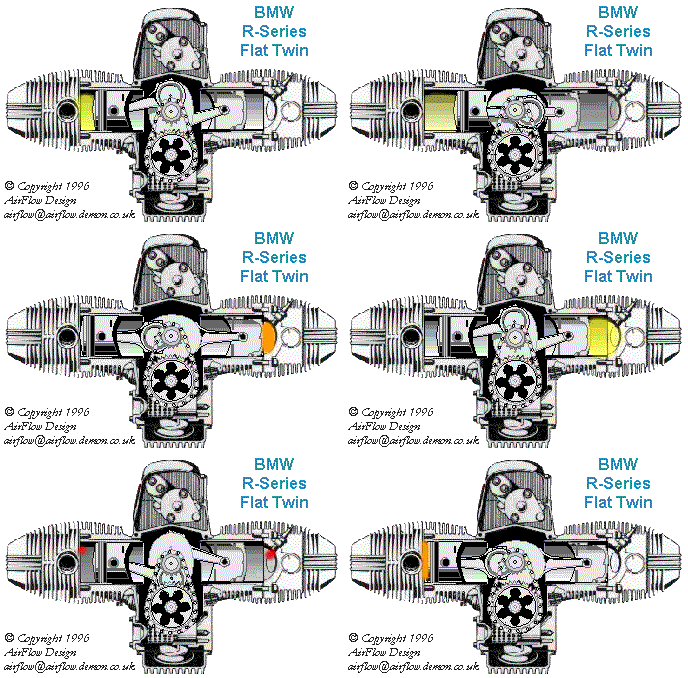
(image from : http://bmwmotorcycletech.info/techindex.htm )
On a multi cylinder with more pistons you CAN have a flat, horizontally opposed engine without having each pair of pistons be at TDC/BDC at the same time because you have more rocking couplets (probably the wrong term tbh) to play with.
(interestingly - that image of an airhead engine system DOES show a wasted spark system.... hmmm, interesting.)
I know exactly what you mean about design criteria and restraints, but I still refuse to believe that BMW would have the injectors firing at the valve on the power stroke....

Re: Understanding the operation of the Motronics 2.4 ECU
Umm, boxermania, how about both pistons at TDC? One is opening intake valves for fresh air/fuel charge, the other sparking compressed mixture before power stroke:
http://commons.wikimedia.org/wiki/File:Box.gif
This is the BMW configuration since 1923.
For the long-used wasted spark boxer implementation, the ignition event on the first cylinder sees exhaust gasses. No harm, no foul. There's a single coil trigger on BMW boxers throughout the airhead range.
For a "wasted injection" setup, the second cylinder would get a squirt of fuel behind closed intake valves. Would like to see someone apply an o-scope to the oilhead system, particularly dual-spark, to verify injector timing and plugs.
http://commons.wikimedia.org/wiki/File:Box.gif

This is the BMW configuration since 1923.
For the long-used wasted spark boxer implementation, the ignition event on the first cylinder sees exhaust gasses. No harm, no foul. There's a single coil trigger on BMW boxers throughout the airhead range.
For a "wasted injection" setup, the second cylinder would get a squirt of fuel behind closed intake valves. Would like to see someone apply an o-scope to the oilhead system, particularly dual-spark, to verify injector timing and plugs.
Re: Understanding the operation of the Motronics 2.4 ECU
If you look at the R1150R wiring schematic, pin 2 (yellow/grey wire) of both injectors are connected to pin 20 of Motronic. Meaning both injectors will fire simultaneously, dumping half load of the required fuel every time Motronic grounding pin 20.
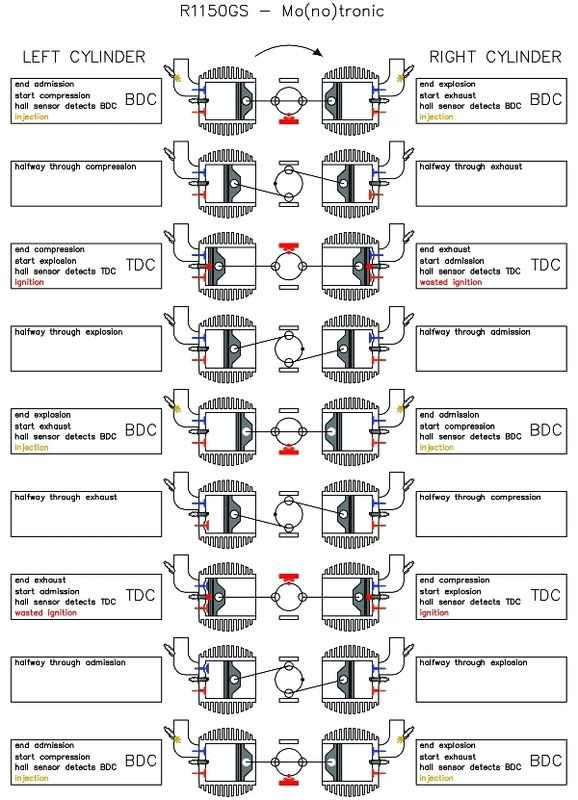
I have got the permission of the author to post it here
I have got the permission of the author to post it here
Re: Understanding the operation of the Motronics 2.4 ECU
phang - That's a great diagram! Please thank the original author for the effort.
Re: Understanding the operation of the Motronics 2.4 ECU
I am still sceptical towards this diagram, it seems the injector always spray fuel to a shut intake valve. Like you said, it is best to hook up a scope to verify the injector firing timing in relation to the crank angle